One of the most frequently asked questions about Stride is:
What is the total supply of Stride?
The answer is clear and straightforward:
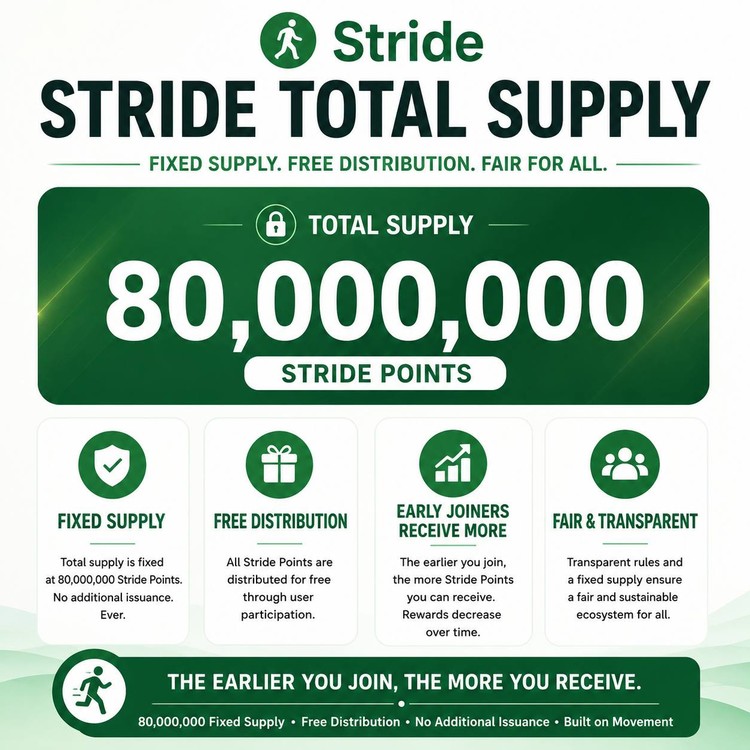
The total supply of Stride is permanently fixed at 80,000,000 (80 million) points, and no additional supply will ever be created.
This means the total supply was determined from the beginning and cannot be increased in the future.
Why Is a Fixed Supply Important?
A fixed supply is one of the foundations of a sustainable digital rewards ecosystem.
If rewards can be created without limits, scarcity may gradually disappear over time. Stride was designed differently. From the very beginning, the maximum supply was permanently set at 80 million points.
Key Features:
Total Supply: 80,000,000 Stride
Fixed Supply
No Additional Issuance
Transparent Distribution
Fair Participation
This structure helps ensure long-term sustainability while maintaining the scarcity of the ecosystem.
How Are Stride Points Distributed?
Unlike many digital assets that require users to purchase them, Stride follows a free distribution model.
All Stride points are gradually distributed to users through participation in the ecosystem, including activities such as walking, engagement, and community contribution.
The core idea is simple:
Everyone should have an opportunity to earn Stride through participation, not through purchasing power.
This allows more people to join the ecosystem and benefit from their daily activities.
Why Do Early Participants Receive More?
Stride uses a phased distribution mechanism.
To reward early supporters and community builders, more Stride points are allocated during the early stages of the project.
As more users join and the available supply decreases, future distributions become smaller.
This means:
Early participants receive more rewards.
Later participants receive fewer rewards.
Distribution gradually decreases over time.
This model recognizes the contribution of early adopters and encourages long-term community growth.
Why Will Rewards Decrease Over Time?
The reason is simple:
The total supply is fixed.
Since only 80 million Stride points will ever exist, the remaining supply available for distribution becomes smaller as more points are released.
To ensure fairness and sustainability, the reward rate gradually decreases as the ecosystem develops.
This mechanism balances growth, scarcity, and long-term stability.
Built Around Walking and Healthy Living
Stride was created around a simple idea:
Turn daily movement into meaningful rewards.
Walking is one of the healthiest and most accessible activities in everyday life. By encouraging people to stay active, Stride aims to build a community where healthy habits are recognized and rewarded.
The goal is not only to reward activity but also to create a long-term ecosystem driven by participation and real-world utility.
The Long-Term Vision of Stride
Stride is designed to be more than just a reward point.
The long-term vision is to connect physical activity with practical everyday applications.
Future use cases may include:
Mobile airtime top-ups
Data package purchases
Electricity bill payments
Peer-to-peer transfers
Merchant payments
Everyday digital services
As the ecosystem expands, Stride aims to create more opportunities for users to benefit from their participation.
Conclusion
Stride has a permanently fixed total supply of 80,000,000 points.
No additional supply will ever be created.
All Stride points are distributed through participation and ecosystem activities rather than unlimited issuance.
The distribution model is designed so that:
The earlier you join, the more rewards you may receive. As the ecosystem grows and more supply is distributed, future rewards gradually decrease.
This combination of fixed supply, transparency, fairness, and community participation forms the foundation of the Stride ecosystem.